Martin G. Choquette,
·
Last updated
·
5 min read
Guide 1 covered what one well-governed AI use case looks like. Many of those use cases arrive through a vendor: a candidate screening tool, a Copilot licence, an AI feature switched on inside software you already pay for. For those, the vendor contract decides what you can do when something goes wrong.
Where a contract is silent on a clause, the vendor’s standard terms usually decide, and you carry what they leave out. Here are the 6 clauses to find in every AI vendor contract, with the rule or case behind each.
Key takeaways
The contract says whether the vendor can train its models on your data and outputs, and what notice it owes you before that changes.
You stay responsible for personal information you hand to a vendor. PIPEDA Principle 4.1.3 says so directly.
The vendor tells you in writing before it changes the model behind your tool.
The liability cap and indemnity decide who pays when an AI output causes harm. In Mobley v. Workday, a US court let discrimination claims proceed against an AI screening vendor as an agent of the employers using it.
Audit rights and an incident notice window shorter than your own reporting deadline let you answer a regulator on time.
An exit clause returns your data in a usable format and confirms deletion in writing.
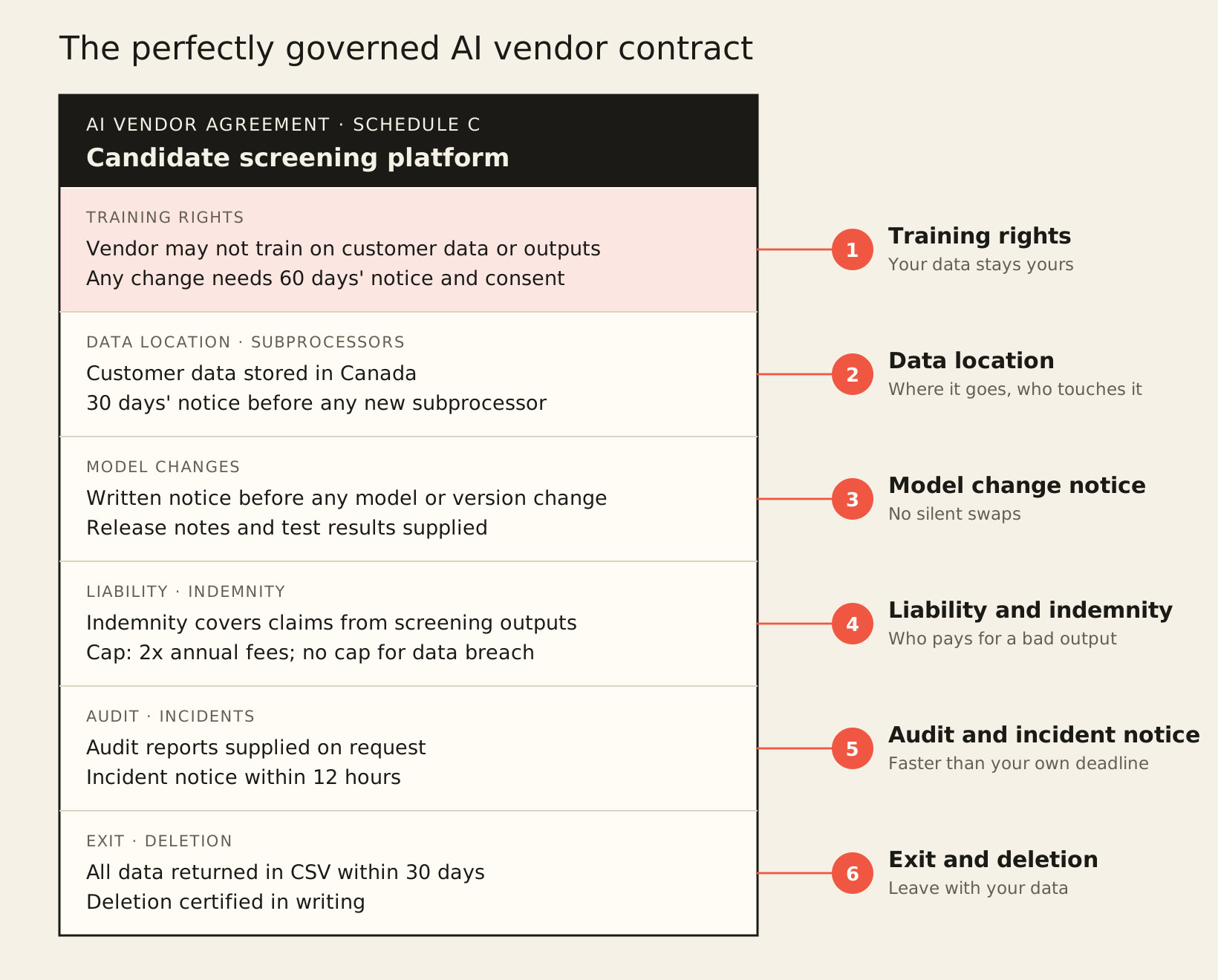
Example schedule for a fictional candidate screening platform. Terms are illustrative.
The 6 clauses
Each clause matches a category in Meninge’s vendor contract review. All 6 fall under Dim 9, Vendor & Third-Party AI Management, in Meninge’s governance scorecard.
1. Training rights over your data and outputs
Review category: model training rights over customer data and outputs
The contract states whether the vendor may use your data, prompts, and outputs to train or improve its models, and what notice and consent it needs before changing that. If the contract is silent, the vendor’s standard terms decide, and those can change.
On February 13, 2024, FTC staff warned that quietly changing terms of service to allow broader data use for AI could be unfair or deceptive. The Office of the Privacy Commissioner of Canada’s draft guidance on assessing third-party service providers, open for comment until December 4, 2026, tells organizations to confirm whether a provider’s technology relies on training data, for example to train an AI algorithm.
Sources: FTC Office of Technology, OPC draft guidance on third-party service providers
2. Where your data goes
Review category: confidentiality, subprocessors, and data residency
The contract names where your data is stored, who else can process it, and how much notice you get before the vendor adds a new subprocessor.
PIPEDA Principle 4.1.3 makes an organization responsible for personal information transferred to a third party for processing, and the OPC expects contracts or other means to give that information comparable protection. OSFI Guideline B-10 (effective May 1, 2024) lets federally regulated institutions require written notice before a vendor adds or swaps a subcontractor, and sets conditions for records held outside Canada.
Sources: OPC Interpretation Bulletin: Accountability, OSFI Guideline B-10
3. Notice before model changes
Review category: model change, version, and behaviour-change notification
The vendor tells you in writing before it changes the model or version behind your tool, with enough detail for you to retest what matters. A model swap can change outputs you already approved.
OSFI Guideline E-23 (effective May 1, 2027) expects externally developed models to get their own risk rating, and its review principle covers third-party models and platforms. A rating goes stale the moment the vendor changes the model without telling you.
Source: OSFI Guideline E-23
4. Liability and indemnity for outputs
Review category: liability cap, excluded losses, and indemnification for claims arising from output
Find the liability cap, the losses it excludes, and whether the indemnity covers claims caused by the tool’s outputs.
On July 12, 2024, in Mobley v. Workday (N.D. Cal.), Judge Rita Lin allowed discrimination claims to proceed against Workday as an agent of the employers using its screening tools. On May 16, 2025, the court conditionally certified an age discrimination collective. Claims about an AI tool’s output can reach both the vendor and its customers. The contract decides who pays.
Sources: Seyfarth Shaw on the July 2024 ruling, Law and the Workplace on the May 2025 certification
5. Audit rights and incident notice
Review category: right to audit, and incident notification scope and timelines
You can get audit reports and evidence when a regulator or customer asks, and the vendor must tell you about incidents fast enough for you to meet your own deadlines.
B-10 lists audit access and vendor incident notification among the contract provisions for critical and high-risk arrangements. OSFI’s incident reporting advisory requires federally regulated institutions to report technology and cyber incidents, including third-party breaches, within 24 hours or sooner. A vendor notice window longer than 24 hours puts that deadline out of reach.
Sources: OSFI Guideline B-10, OSFI Technology and Cyber Security Incident Reporting
6. Exit, data return, and deletion
Review category: exit, data return, and deletion on termination
The contract says how you leave: which data comes back, in what format, how fast, and how deletion is confirmed.
B-10 expects data and records to be returned in a format that lets the institution keep operating after the arrangement ends.
Source: OSFI Guideline B-10
Check your 3 largest AI vendor contracts
Find each of the 6 clauses in the main agreement, the data processing addendum, and any AI addendum. A contract you can’t locate counts as a finding. Rate each clause on the scale we use in vendor reviews:
Low: the clause covers it. No action needed.
Moderate: present but narrow or vague. Revisit at renewal.
High: missing, or it favours the vendor in a way you can’t absorb. Renegotiate before you sign or expand use.
Critical: you carry a liability, regulatory, or continuity exposure with no remedy. Escalate to your General Counsel.
Then write one person’s name next to every clause rated High or Critical. A finding with no owner will still be open at the next review.
Frequently asked questions
Does this apply to AI features inside software we already license?
Yes. AI features can be switched on inside platforms you already pay for and run under the original contract, which may say nothing about training rights or model changes. Check that contract against the 6 clauses.
The vendor won’t change its standard terms. What then?
Rate the gap anyway, and have a named owner accept it in writing with a review date. A gap rated Moderate for a pilot can become High when the tool touches more decisions or more data.
We aren’t a bank or insurer. Why cite OSFI?
B-10 and E-23 bind federally regulated financial institutions only. They appear here because they are the most detailed public Canadian lists of what a third-party model and contract arrangement should cover. PIPEDA’s accountability principle applies to private-sector organizations across Canada, except where a province has its own substantially similar private-sector privacy law, such as Quebec, British Columbia, and Alberta.
In a 90-Minute Pressure Test, we take one of your live AI use cases or vendor contracts and tell you which gaps carry the most risk.
Martin Choquette
Founder of Meninge, an AI strategy and governance practice for mid-size organizations in Canada and the US. AIGP-certified (IAPP). Based in Ottawa.
